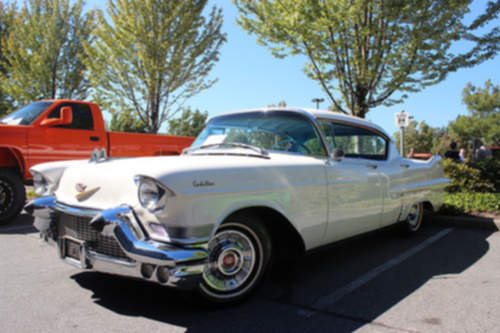
The '59 Caddy had it all -- looks, performance, and comfort. It stood as
the ultimate symbol of success, impressive and -- yes -- controversial. The
outrageous tail fins and jet pod taillights evoked either a love it or leave it
attitude with the public. It is interesting to note that Maurice D. Hendry,
author of Cadillac: Standard of the World, The Complete Seventy-Year
History, refused to include a picture of the regular production '59
Cadillac in his book. He said that, "This year saw the tail fins reach a
literally ridiculous height.... The fins had plenty of critics including this
writer.... Nevertheless, the 1959s overall were excellent.... As cars -- rocket
fins or not -- they were undeniably excellent."
Walter M. P. McCall, in
80 Years of Cadillac-LaSalle agreed, commenting that the 1948
tailfins "soon became Cadillac's most famous styling feature, but with each
successive series of new cars these rear fender appendages grew higher and
more flamboyant. By the late 1950s they had reached ludicrous proportions
and were of questionable taste." He called them "Cadillac's spectacular 'zap'
fins!" Up front, McCall observed that "The new grille was a glittering cliff
of chrome. And as if one toothy grille wasn't enough there was even a
dummy grille across the lower rear deck of most models. A thin, horizontal
blade divided the jewelled front grille into upper and lower sections.
Parking and turn signal lights were paired in pods at the outer ends of the
massive new front bumper. The new rear bumper had huge, chrome outer
pods with backup lights recessed in their centers."
Of course, just about everybody knows about the monster fins on the
'59 Cadillac. But how many have ever heard about the Cadillac designed
around a Buick door? The 1959 Cadillac was. General Motors had gone
through three expensive years of tooling up for new models and the head
honchos wanted to trim costs. They decided to make the basic Buick
front door a common interchangeable element throughout the GM C-body
line. This was a tough directive because the door tapered rearward, but an
order was an order and the Cadillac design team worked around it, turning
out an unforgettable product in the process.
Dave Hols, now Director of Design with the General
Motors Design Staff, was a designer at the Cadillac styling studio in 1956.
He remembers the Buick door challenge quite well. "Boy, did you guys see
those '57s parked down at the end of Mound Road?, " Hols recalls one
designer asking as he came into the studio one morning. The designer was
referring to the befinned 1957 Chrysler cars. Actually, Cadillac had
started the great automotive fins race in 1948 after styling chief Harley
Earl had sent a group of designers out to Selfridge Field near Detroit to
study a Lockheed Lightening P-38, particularly its rear stabilizers. Now,
almost a decade later, Chrysler's cars were out-finning Cadillac -- and in a
bold way at that. In point of fact, Chrysler had temporarily wrested design
leadership from GM, and that could not be tolerated.
Thus, Chrysler's challenge set the
Cadillac design team's creative course -- the '59 Cadillac was going to have
flamboyant fins. All the designers were disenchanted (some to the point of
hate) with the '58 Caddy and they were going to abandon most of its
design themes. And just as the 1958 Lincoln and Continental Mark III set
out to "out-Cadillac" Cadillac in 1958, Cadillac found itself in the curious
situation of trying to "out-Chrysler" Chrysler in 1959!
Retired Vice-President of Design, Bill Mitchell,
remembers the battle with Chrysler. "I think what happened is that at the
time [Virgil] Exner at Chrysler and we at GM tried to out-fin each other. I
think the worst year we had was '58 when we were putting on chrome with
a trowel. We had chrome on everything, and in '59 we tried to out-fin
Exner. You know, we went on to '60 and '61 and brought the fins down
and made them a little more sane -- a little more 'sanitary.'"
The head of GM styling at the time was
Harley Earl, the Father of modern automotive design. But he was away in
Europe when this inspiration came to the Cadillac design staff. "When the
cat's away...."
Every designer on the project was enamored of jet
aircraft. It was nothing to see a stack of books on the subject on their
desks. This was an exciting time in aviation and the designers were awed
by the shapes of the latest jets. True, the P-38 influence continued on the
'59 Cadillac with the flow-through lines. As Mitchell said, "Seeing the
P-38, you saw how you could go from the headlight straight back to the
tailfin in one line." But, as Hols puts it, "By the mid-Fifties, jet aircraft
were the thing." If you look at the rear of the '59 Caddy, it looks like the
exhaust ports of a jet. It's no wonder the '59 Caddy looks like it's really
moving even when it's just sitting in the driveway.
All the right ingredients came
together for the creation of the '59 Cadillac. First, GM was doing all-new
vehicles for 1959. Second, the taper in the Buick door dictated Cadillac's
rearward taper. Finally, Ed Glowacke, head of design at Cadillac, wanted a
new, innovative, state-of-the-art design. Cadillac could do nothing less than
Chrysler and still be competitive, Glowacke thought. So he put his crew on
a rush schedule to get the 1959 design completed. Work began about
October 1956, with the car set for an October 1958 introduction. Compared
to other GM design time-tables, that was incredibly fast and meant many
late hours in the studio.
Dave Hols, working with Glowacke and crew,
developed the distinctive tailfin design. Twin taillights were used because
twice as many looked more expensive. Thus, nacelles were designed into
the tailfins to allow for them. Chuck Puhlman and Roy Hill also worked on
the design. In the end, use of the Buick door cost more than originally
projected, mainly because of the taper and drop in height. Without that
taper, however, the car's lines wouldn't have carried the characteristic
sweep of motion that became such a distinctive part of the car's design --
and certainly we would not have seen those huge fins.
One of the most striking
impressions one receives from inside the '59 Cadillac is a marvelous
feeling of openness. That's because 1959 was also the "greenhouse year" at
GM. The entire lineup boasted unexcelled visibility compliments of the
thin pillars and abbreviated sail panel (really only a pillar itself). Sitting in
the car, the driver could easily see all four corners and enjoy an almost
unobstructed view in all directions. Part of the increase in visibility had to
do with the design of the roof. In fact, the buyer could choose from two
distinctive roof designs, the first a more traditional curved roof, the second
a radical "blade-upper" flat roof. Both lent themselves to creating lavish
vistas of visibility.
Interior planning for the 1959 Cadillac, including the
Eldorado Brougham and limos, was directed by Bob Scheelk, head of
Cadillac interior design. He remembers the project as a rush program; he
was asked to have the instrument panel in clay -- with working instrument
lights -- for the GM Board of Directors at the Tech Center in the spring of
1957, a monumental task. As it turned out, the executives approved the
instrument panel for production pretty much as presented. It was quite deep
because of the depth of the cowl and the rake of the wraparound
windshield, which resulted in an extended shelf. Also working on the
interior were Sue Vanderbilt (who had worked on Cadillac exteriors
earlier); Russ Bolt, a studio engineer; and two clay
modelers.
Of course, Cadillac shared a number of
parts with other GM cars, mainly the structural pieces hidden from view.
Cadillac's interior also shared components with its GM siblings -- items
like door moldings and openings, window surrounds, and seat frames. But
most of what the buyer saw, including the seat cushions and fabrics, was
unique.
The extreme curvature of the windshield
caused some rethinking regarding placement of controls and switches. For
example, the section of the dash which curved around on the driver's side
to the door opening was large enough that the designers referred to it as
the "horn." On it, they placed the windshield-wiper controls and the power
window switches. Originally, the cruise control was located there, too, but
it had to be moved because it conflicted with the other
controls.
Because so many components were new,
even the door opening mechanism for example, extra care had to be taken
to maintain Cadillac's reputation for high quality. One problem in this
regard was the metallic fabric used on the Fleetwood Sixty Special; it
trapped the guard-hairs of women's mink coats when they sat down and
hung onto the hairs when they got up. This textile problem was rapidly
addressed and solved.
Scheelk came up with the colors, had some cars
painted, and hosted an outdoor color show for management at Cadillac
engineering on Clark Street. There, a vote was taken. Only after the
formulas for the selected colors were developed and the problems worked
out did the colors receive final approval. Cadillac often boasted about its
Magic-Mirror acrylic lacquer finish.
All 1959-60 Cadillacs came with
Hydra-Matic, power steering, and power brakes as standard. They also
featured a new direct-acting power brake booster and automatic-release
parking brake. Of course, there was a long list of options: cruise control,
air suspension (whose shocks now contained plastic bags of inert Freon-12
so that the gas could not mix with the shock absorber fluid), electric door
locks, Autronic Eye headlight dimmer, power windows and seat, air, E-Z
Eye glass, power trunk with pull-down, and more.
The '59 Caddy rode a 130-inch wheelbase and
stretched 225 inches from bumper to bumper. At 54.8 inches, the two-door
hardtop stood three inches lower than it had the previous year. Cadillac
used a tubular-center X-frame, not only for its exceptional strength, but
also because it allowed for a low body to improve appearance and enhance
handling stability. The V-8 was bored for 1959, upping the displacement
from 365 to 390 cid and the horsepower from 310 to 325. A four-barrel
carb and dual exhausts were standard. Even the car's rear end, available
with four ratios from 2.94:1 to 3.77:1, had been redesigned, but mainly for
a quieter ride.
DeVille now became a distinct series,
offering hardtop sedans with flat-top four-window styling and a curvier
six-window roofline, plus a hardtop coupe. The Series 62 duplicated these,
and added a convertible. Still pillarless (as it had since been since '57), the
lush Sixty Special now shared a new 130-inch wheelbase with all other
standard models, including the line-topping Eldorado trio of Seville,
Biarritz, and Brougham.
Prices were generally higher than before, with Series 62s at around $5000 and Eldos going for $7400 and up.
Still, Cadillac built over 142,000 of its '59s, a fair gain on its 1958 showing. Though not
appreciated then, these Caddys are now sought-after as the epitome of
Fifties kitsch with their massive size, sparkling trim, and, especially, those
overblown fins.
Despite a few lapses, the Fifties had been a great 10 years for Cadillac -- the greatest ever in terms
of expansion. A car for the very wealthy in 1950, Cadillac was solidly
entrenched by decade's end among younger buyers on the way up.
In 1959, Cadillac fielded six series: Series 6200, 6300 (DeVille), 6400 & 6900 Eldorados, Sixty Special
Fleetwood, and 6700 Fleetwood 75.
No single automotive design better characterizes the industry's late Fifties flamboyance than the 1959 Cadillac, which incorporated totally new styling:
The convertible also had power windows and Two-Way power seat. Plain fender skirts covered rear wheels and
sedans were available in four window (4W) and six-window (6W) configurations.
| The motor serial number system adopted in 1958 was used again with numbers in the same physical locations. |
| The first pair of symbols changed to "59" to designate model year. |
| The third symbol (a letter listed as a Body Style Number suffix in charts below) identified model and series. |
| Consecutive unit numbers began at 000001 and up |
NOTE: The Export Sedan was shipped in CKD form to foreign countries.
The DeVille models, two sedans and a coupe, had script nameplates on the rear fenders eliminating the use of
the front fender crest medallions. They were trimmed like 6200s otherwise. The DeVilles also had all of the
same standard equipment listed for 6200s plus power windows and Two-Way power seats.
| Type | V-8 Overhead valves |
| Block | Cast iron block |
| Displacement | 390 cubic inches |
| Bore and stroke | 4.00 x 3.875 inches |
| Compression ratio | 10.5:1 |
| Brake horsepower | 325 at 4800 rpm |
| Bearings | Five main bearings |
| Valve Lifters | Hydraulic valve lifters |
| Carburetor | Carter AFB four-barrel Model 2814S |
| Wheelbase | 130" |
| Overall Length | 225" |
| Tires | 8.00 x 15 |
| Dual exhausts | standard |
| Rear axle ratios | 2.94:1 standard; 3.21:1 optional or mandatory with air conditioning |
| The 345 horsepower Eldorado V-8 was optional on all other Cadillacs at $134.30 extra. |
| Radio with rear speaker | $165 |
| Radio with rear speaker and remote control | $247 |
| Automatic heating system on Series 75 | $179 |
| Automatic heating system on on other models | $129 |
| Six-Way power seat on 6200s except convertible | $189 |
| Six-Way power seat on 60-6306-6400 and 6200 convertible | $89 |
| Power window regulators | $73 |
| Power vent regulators | $73 |
| Air conditioning on Series 75 | $624 |
| Air conditioning on other models | $474 |
| Air suspension | $215 |
| Autronic Eye | $55 |
| Cruise Control | $97 |
| Electric door locks on two-doors | $46 |
| Electric door locks on four-doors | $70 |
| E-Z-Eye glass | $52 |
| Fog lamps | $46 |
| White sidewall tires 8.20 x 15 four-ply | $57 exchange |
| 8.20 x 15 six-ply | $65 exchange |
| Door guards on four doors | $7 |
| Door guards on two doors | $4 |
| Remote control trunk lock | $59 |
| License Plate frame | $8 |
| Utility kit | $15 |
| Monogram | $12 |
| Acryllic Lustre finish | $20 |
| Undercoating | $25 |
| Radio foot switch | $10 |
| Gas cap lock | $4 |
| Pair of rugs for front | $8 |
| Pair of rugs for rear | $5 |
Books about Cadillac |
History of LaSalle |
Books on other automobiles |
|---|
|
|
|
|
|
|
|---|