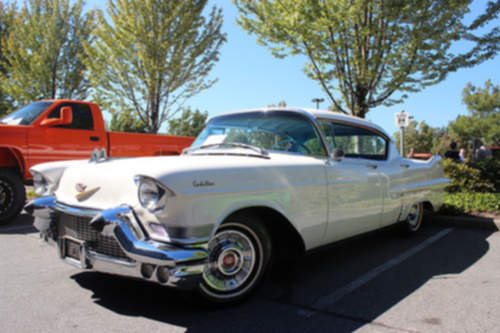
1946 Cadillac Sedanet
Ending a hurried production run that had begun four years earlier, just after Pearl Harbor, the last M-24 tank rolled off the Cadillac assembly line on August 24, 1945. Amazingly, the first '46 Caddy was produced on October 7, 1945.
By necessity, the '46 Cadillac was a quickly thrown-together rehash of
what Cadillac had offered in 1942, and only Series Sixty-Two four-door
sedans were built at first. Cadillac ads made much of the fact that their
"Battle-Proved" engines and transmissions were the only automotive
components continually produced without interruption during the
war, and improved along the way to boot. A major modification, however,
was the adoption of a negative battery ground.
Styling changes were minimal, though noticeable. Rectangular
parking lights resided on the upper portion of the slightly modified grille
(with fewer vertical bars), and wraparound bumpers were adopted front and
rear. The front of the hood and the decklid now sported the Cadillac crest
nestled in a "V," which would become a long-standing trademark, so the
Cadillac block lettering was moved to the front fenders.
Model offerings were pared to just 11 for 1946. Gone
entirely were the Series Sixty-Three and Sixty-Seven, while the Sixty
Special lost its division-window model, as well as the vertical chrome
strips on the
fenders. The latter were replaced by five hash marks on each C-pillar.
Series Sixty-One and Sixty-Two continued with the coupe and sedan, and
the later boasted the only convertible in the lineup as since 1941. The
Series Seventy-Five, meanwhile, was pared to five models, down three,
although five-, seven-, and nine-passenger models were still listed, as were
the Imperial models with divider windows. Seventy-Fives traded the hood
louver decorations and triple fender speedlines of '42 for an almost
full-length chrome strip starting at the front of the hood, and gained
stainless steel running boards. Cadillac block lettering was moved to the
lower front fenders.
Strikes and materials shortages, particularly of sheet steel, were
major industry-wide problems during the '46 production year. Thus, some
Cadillacs went through the assembly lines with only brackets to hold
temporary wooden bumpers -- the real ones had to be installed by dealers
as they became available later.
Pressure on Cadillac to produce was intense. Even in
1947, there were still almost 100,000 unfilled orders for what one division
sales manager, D. E. Ahrens, called "... one of the most sought-after, and
most scarce items in the world today." People knew Cadillac's value and
prestige, and that was what they wanted, but due to the early postwar
difficulties only 29,214 customers got to drive a '46 Caddy
home.
And those that managed
to get one paid for the privilege, as the price-leader Sixty-One fastback
now started at $2052, up a whopping 41.5 percent over 1942. The Business
Imperial nine-passenger sedan, the most expensive 1946 offering, listed at
$4346, up $1266, or 41.1 percent. Of course, pricing was a problem for all
automakers in the inflationary days following the war.
In 1946 four models were offered: Series 61, Series 62, Series 60 Special Fleetwood, and Series 75 Fleetwood.