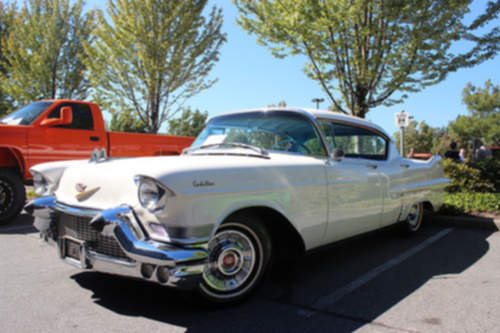
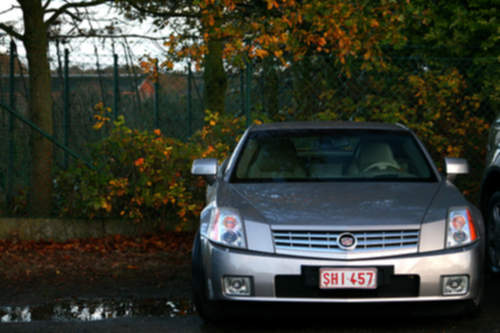
1981 CADILLAC

The biggest news for 1981 was actually an '82 model: the new subcompact Cimarron, introduced in the spring. (More on that in the next section.)

The second biggest was the new variable-displacement gasoline engine, developed by the Eaton Corporation a standard in all models except Seville. Depending on driving conditions, the innovative V8-6-4 engine ran on four, six, or eight cylinders, switching back and forth as needed. The object, of course, was to conserve fuel in the wake of rising gasoline prices. A microprocessor determined which cylinders weren't necessary at the moment. Then it signalled a solenoid-actuated blocker plate, which shifted to permit the rocker arm to pivot at a different point than usual. Therefore, selected intake and exhaust valves would remain closed rather than operate normally. Valve litters and pushrods traveled up-and-down in the normal manner, but unneeded valve pairs stood idle. When running on four, displacement grew back to eight as soon as you stepped on the gas to pass, demanding maximum power -- an assurance to those who might wonder if a four-cylinder Cadillac powerplant was good enough. The system had been tested (and "Proven") in over half a million miles of driving. Cadillac claimed that the "perceived sensation" during displacement changes was "slight." because no shifting was involved.

Another feature: push a button and an MPG Sentinel showed the number of cylinders in operation; push again to see instantaneous miles-per-gallon. Though the principle was not new, having been experimented with during World War II, the new engine was hailed as a dramatic answer to the economy problem for large passenger cars. Expanded self-diagnostics now displayed 45 separate function codes for mechanics to investigate. Imaginative but complex, the V8-6-4 brought more trouble than ease to many owners and didn't last long in the overall lineup. Although it lasted for only a year, limousines kept it for several years longer.

On another level, Buick's 252 cu, in. (4.1-liter) V-6 engine, introduced late in the 1980 model year, continued for a full season as an economy option.

Cadillacs now carried an on-board digital computer capable of making 300,000 decisions per second. It could even provide continued operation of the car if critical sensors malfunctioned, making an instantaneous substitution -- even turning to a built-in analog computer if the digital electronics collapsed. To improve emissions, the new Computer Command Control module used seven sensors to monitor exhaust, engine speed, manifold air pressure, and coolant temperature, then adjust the air/fuel mixture.

"Answering Today's Needs with Tomorrow's Technology" was the logical theme of the full-line catalog. Though technically impressive, 1981 was not a year of significant change beyond some new grilles and other cosmetic alterations. Oldsmobile's 350 cu. in. diesel V-8 was available in all six models: Fleetwood Brougham coupe and sedan, Coupe and Sedan DeVille, Eldorado, and Seville. A new light went under the hood. Rust-prevention measures touched over 100 specially treated areas, including pre-coated metals. Overdrive automatic transmission was now available with the V-6 engine on Fleetwood Brougham and DeVille. A memory seat option returned the six-way power driver's seat to one of two selected positions.

I. D. DATA

All Cadillacs had a new 17-symbol Vehicle Identification Number (VIN), stamped on a metal tag attached to the upper left surface of the cowl, visible through the windshield.
The number begins with a "1" to indicate the manufacturing country (U.S.A.), followed by a "G" for General Motors and a "6" for Cadillac Division.
The next letter indicates restraint system:
  • "A" manual (standard);
  • "B" automatic.
Symbol five is a letter denoting car line and series:
  • "S" Seville;
  • "B" Fleetwood Brougham;
  • "D" DeVille;
  • "F" Fleetwood limousine;
  • "Z" commercial chassis;
  • "L" Eldorado.
Digits six and seven indicate body type:
  • "47" 2-door coupe;
  • "69" 4-door four-window sedan;
  • "23" six-window, eight-passenger sedan w/auxiliary seat;
  • "33" six-window formal limousine w/aux. seat and center partition; "90" commercial chassis (no body); "57" Eldorado coupe.
Next comes an engine code:
  • "4" V6-252 4-bbl.;
  • "N" V8-350 diesel;
  • "6" V8-368 4-bbl.;
  • "9" V8-368 DFI.
The next symbol is a check digit.
Symbol ten indicates model year ("B" 1981).
Symbol eleven denotes assembly plant: "9" Detroit; "E" Linden, New Jersey (Seville/Eldorado).
The final six-digit production sequence number began with 100001 for Detroit-built models: 600001 (Eldorado) or 680001 (Seville) for those built in New Jersey.
An identification number for the V-6 engine was on the left rear of the block; on the V8-350, a code label was on top of the left valve cover and a unit number label atop the right valve cover.
Other engines had a unit number on the block behind the left cylinder head, and a VIN derivative on the block behind the intake manifold.
  • A body number plate on the upper horizontal surface of the shroud (except Seville, on front vertical shroud surface) showed model year, build date code, car division, series, style, body assembly plant, body number, trim combination, paint code, modular seat code, and roof option.
  • HISTORICAL NOTES

    PREVIOUS: History of the 1980 Cadillac
    NEXT: History of the 1981 Cadillac DeVille
    NEXT: History of the 1981 Cadillac Eldorado
    NEXT: History of the 1981 Cadillac Seville
    NEXT: History of the 1981 Cadillac Fleetwood
    NEXT: History of the 1982 Cadillac

    Caddy books
    Books about Cadillac
    LaSalle
    History of LaSalle
    auto books
    Books on other automobiles


    1978 1979 1980 1982 1983 1984
    Sign My Guestbook Get your own FREE Guestbook from htmlGEAR View My Guestbook

    Valid HTML 4.01 Transitional Valid CSS!

    copyright Motorera.com