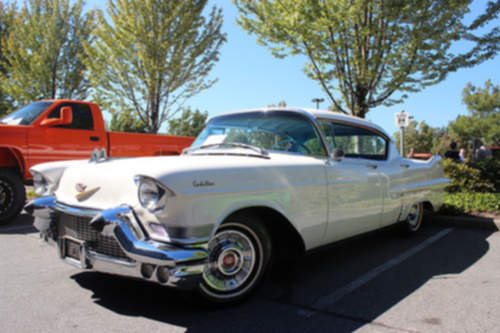
Cadillac's 75th anniversary year arrived with a shock to traditionalists, as full-size models endured an eye-opening downsizing. "You must drive it," the ads declared, "to see why we call it the next generation of the luxury car." The new C-bodied DeVille, Brougham and limousine were 8 to 12 in. shorter, 3-1/2 in. narrower, and an average of 950 pounds lighter than their massive predecessors. Still, many models managed to keep the same leg room in front and rear (or even more). Only Eldorado carried on in its mammoth form a while longer, and Seville had entered life in 1975 with contemporary dimensions. Even the commercial chassis shrunk, from 157.5 down to 144.5 inches in wheelbase, requiring funeral car and ambulance suppliers to create some new bodies.
All models except Seville carried a new lighter, smaller 425 cu. in. (7.0-liter) V-8 engine. That powerplant emerged as the result of testing 110 experimental engines. The huge 500 V-8 was gone. Electronic fuel injection was optional in DeVille, Brougham, and Eldorado. Standard Turbo Hydra-matic fed power to low-ratio drive axles. Four-wheel disc brakes were standard on Seville, Eldorado and Brougham. Astroroofs and sunroofs were again available. Carryover special editions included Coupe and Sedan DeVille d'Elegance and Brougham 'Elegance.
One new special edition joined the lineup: the Eldorado Custom Biarritz. All sedans now had piliars and framed door glass. (The 'true' four-door hardtop was gone for good.) With Calais departed, DeVille took over as the cheapest Caddy (base price under $10,000). Dash gauges could be pulled out from the front for servicing. All models had a new two-spoke steering wheel -- but those were wide spokes. A new door design offered better hold-open qualities. Anti-corrosion treatment on all models included zinc-rich primers, hot melt sealers, wax coating, Plastisol-R-, and deadeners. Cadillac also expanded the use of Zincrometal-R- and bi-metal (stainless steel on aluminum), corrosion-resistant inner front fender panels, and elimination of areas that trapped dirt and water. Wheels and tires were now match-mounted for smoothest ride.
For 1977, there were five models:
| All Cadillacs again had a 13-symbol Vehicle Identification Number (VIN) on the forward lower edge of the windshield frame, visible through the windshield. |
| The first digit ("6") identifies the Cadillac Division. |
The second symbol denotes car line/series:
|
Digits three and four indicate body type:
|
Next comes the engine code:
|
| Symbol six indicates model year ("7" 1977). |
Seventh is an assembly plant code:
|
At the end is a six-digit sequence number:
|
| A nine-digit derivative of the VIN appears on the engine. |
| A Body Number Plate has codes for model year, model number, trim combination, body number (assembly plant and sequence built), paint color(s), and a number-letter code that shows the date built. |
| That plate is mounted on the upper left cowl between hood rear seal and windshield except Eldorado, on left side of cowl next to hood rear bumper; and Seville,riveted to cowl above evaporator case. |
|
![]() |
![]() |
|---|
Books about Cadillac |
History of LaSalle |
Books on other automobiles |
|---|
![]() |
![]() |
![]() |
![]() |
![]() |
![]() |
|---|