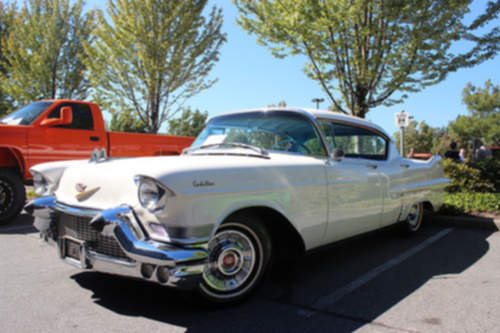
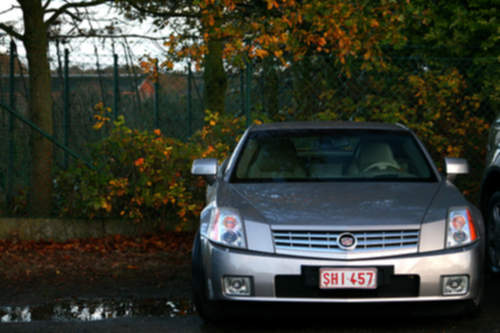
Cadillac began reaching for U.S.
luxury-car leadership in the Thirties, and clinched it for good in the Fifties.
Symbolizing its achievement was the 1958 death of Packard, once
America's premier prestige make, due to an over-long reliance on
medium-price products and a crippling 1954 merger with troubled
Studebaker. Lincoln would never threaten Cadillac's supremacy in the
Fifties, owing to a more limited lineup. Nor would Chrysler, even after
spinning off Imperial as a separate make after 1954.
Several developments in the Forties laid the
foundation for Cadillac's high Fifties success. First, the division returned to
prestige cars exclusively after 1940, abandoning its medium-price LaSalle once
the luxury market recovered from its Depression-era doldrums. Then
Cadillac landed a formidable one-two postwar punch: tailfin styling for '48,
followed by a landmark new overhead-valve V-8 for 1949, when the
division also pioneered (with Olds and Buick) the instantly popular new
hardtop convertible body style. About all Cadillac needed in the Fifties
were styling and features that pleased most buyers most of the time, which
it delivered.
Initially sized at 331 cubic inches, the Cadillac V-8 was the product of 10
years research and experimentation. It was mainly engineered by Ed Cole,
Jack Gordon, and Harry Barr, who aimed for less weight and higher
compression (to take advantage of the higher-octane fuels promised after
the war). These factors dictated the overhead valve arrangement, a stroke
shorter than bore (3.63 inches, versus 3.81), compact wedge-shape
combustion chambers, and "slipper" pistons. The last, developed by Byron
Ellis, traveled low between the crankshaft counterweights, allowing for
short connecting rods and low reciprocating mass.
With all these advantages, the ohv arrived with 160 bhp, 10 more than
Cadillac's last 346 L-head V-8 -- and from less displacement,
testifying to its efficiency. The ohv had other advantages. Though built of
cast iron, like the L-head, it weighed nearly 200 pounds less, yet would
prove just as durable and reliable. Initial compression was only 7.5:1, yet
could be pushed as high as 12:1; the L-head couldn't. The ohv also boasted
more torque and 14-percent better fuel economy. Equally important, it had
room enough to be greatly enlarged -- as it soon was.
This superb engine combined with a surprisingly competent chassis to
make early-Fifties Cadillacs some of the best road cars of that day.
Chicago enthusiast Ed Gaylord, who backed the short-lived Gaylord car of
mid-decade, owned a 1950 Series 61 with standard shift and 3.77 rear axle.
He also had a new Jaguar XK-120 at the time. Gaylord later said that "the
Cadillac was the faster car up to about 90 mph. [It also] set what was then
a stock-car record at the original quarter-mile drag races in Santa Ana,
California .... The only competition I had in acceleration was from the
small 135-horsepower Olds 88 coupe, but the Cadillac engine was
substantially more efficient both in performance and economy." Indeed,
such a car could clock 0-60 mph in around 13 seconds and easily top 100
mph.
Further proof of the V-8's prowess was provided by sportsman
Briggs Cunningham, who entered a near-stock 1950 Cadillac in that year's
24 Hours of Le Mans in France. Driven by Sam and Miles Collier, it
finished 10th overall -- a performance unmatched by any other production
luxury car -- tearing down the Mulsanne Straight at around 120 mph and
averaging 81.5 mph for the entire event. Cunningham himself drove a
streamlined Cadillac-powered special that the French called Le Monstre. He
went even faster than the Colliers, but lost top gear and finished right
behind them. Perhaps most impressive, a British-built Allard J2, powered
by the same Cadillac V-8, finished third.
Of course, such exploits mattered less in showrooms than the smooth,
powerful V-8 itself. And Cadillac had another advantage going into the
Fifties: GM's equally smooth and efficient self-shift Hydra-Matic Drive, by
then standard on all models except the low-priced Series 61. Together with
the V-8, it made for luxury-car performance demonstrably superior to that
of rival heavyweights with less vigorous drivetrains. Though the V-8 would
remain at 331 cid through 1955, it gained over 100 bhp in the interim,
reaching 270 on that year's Eldorado.
Prices for the 1950 line started at $2761 for the Series 61 coupe (although
few models went for under $3000) and reached up to about $5000 for a 75
sedan or limo. The 61s cost about $575 less than comparable 62s. Division
sales topped 100,000 for 1950
Alas, Cadillac styling ultimately drifted to chrome-laden glitter, reaching a
low point with the 1958-59 models. But the basic 1948 tailfinned design,
inspired by wartime aircraft and originated by Franklin Q. Hershey under
the watchful eye of GM design director Harley Earl, was good enough to
remain largely intact through 1953. A fairly important change is that,
unlike sister GM divisions, Cadillac completely abandoned Forties-style
fastbacks for 1950, switching pillared coupes to notchback profiles with
hardtop-type rooflines inspired by the successful 1949 Coupe de Ville.
Books about Cadillac |
History of LaSalle |
Books on other automobiles |
|---|
|
|
|
|
|
|
|---|