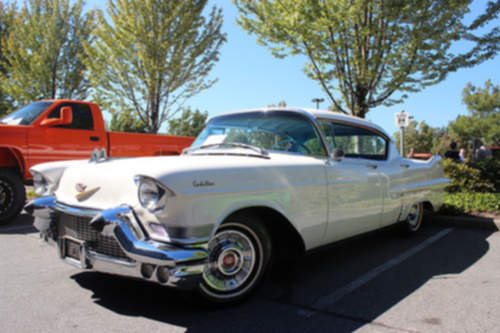
There was a prevailing belief that the '42s were not as well built as the '41s. This wasn't quite true, although the use of lightweight cast-iron pistons instead of aluminum was common. Shoddiness showed up in chrome trim with thin layers of copper and nickel understrikings, or in the inferior grade of plastic that was used everywhere, especially in interior hardware and dashboards. Even the upholstery didn't seem to be quite up to previous standards.
The 1942 Cadillacs were basically similar to '41, but with prices starting at $1450
(up $105) and with longer 129- and 133-inch wheelbases for the Series Sixty-Two and
Sixty Special, respectively. Body shells were reworked to look rounder and more
massive -- it's debatable that they looked any better. Keynotes of Cadillac's
facelift were long pontoon fenders that extended into the front doors, a theme repeated on the rear fenders, and a
more massive diecast egg-crate grille. After 1942, the Series Sixty-Three and Sixty-Seven were discontinued.
Only 16,511 units were built before production switched to M-24 tanks, aircraft engines, and munitions.

1942 Cadillac
Cadillac entered 1942, its Fortieth Anniversary year, with the same 150-bhp V-8 and six series, but model
choices were pared to 22. Gone were the two Sixty-One DeLuxes, the Sixty-Two convertible sedan, and the
Sixty Special Town Car. Prices now ranged from $1450 to $4060. The 1942 Cadillac was -- and is -- fairly rare
because output was halted on February 41 1942. The U.S. had entered World War II on December 8, just hours
after the Japanese bombing of Pearl Harbor, forcing an industry-wide conversion to the manufacture of war
materiel. And in fact, the U.S. Office of Production Management had ordered auto production cutbacks back in
August 1941, to 73.5 percent of 1940 output.

1942 Cadillac
If 1941 was the year of the eggcrate grille at Cadillac, then '42 was the year of the bullet -- or pontoon -- shaped
fenders. They caused the '42 design to come across as bulkier, particularly the bulbous front units, which swept
rearward well into the doors. This fender treatment had apparently developed in the stylists' minds over several
years, for one drawing done at the GM studios as early as 1934 showed the extended fender line explicitly. And,
of course, it was seen in production on the '41 Sixty Special, albeit in a more squared-off form.

1942 Cadillac
For 1942, Cadillac boasted a wider, bolder eggcrate grille with round parking lights and rectangular fog lamps
(when not ordered, fluted chrome caps took their place). Also up front, a seed had been planted that would grow
enormously over the years to come, for there on the front bumper was a pair of small (almost embryonic)
"Dagmar" bumper extensions. Ed Glowacke would fully develop this design motif in the mid-Fifties.

1942 Cadillac
Cadillac advertised its sealed, ribbed Super-Safe brakes and made a point of demonstrating its All-Weather
Ventilation System, which allowed an unobstructed flow of air into the car even in the rain. In addition, a T-type
parking brake handle was adopted. The Sixty Specials and Sixty-Twos featured a new instrument panel, as well
as longer wheelbases: 133 and 129 inches, respectively The Sixty-Two boasted a new fastback coupe, the
Sedanet. Looking even more aerodynamic than the Sixty-One fastback, it was easily identified by its longer rear
side windows.

1942 Cadillac
The Sixty Special lost some of its uniqueness as Cadillac continued to consolidate its offerings. It now looked
much like the regular Cadillacs, with thick center window posts and single chrome spears on all four fenders.
The Special, however, sported a series of 14 vertical chrome hash marks on the lower edges of both the front
and rear fenders. Fender skirts were standardized across the board.

1942 Cadillac
It should be noted that although the Seventy-Fives adopted the new '42 front-end styling, they retained 1941's
short, square fenders and triple chrome strips behind the wheels. In fact, they would carry on with the same
square-rigged lines through 1949.

1942 Cadillac
Washington issued "black-out" orders to Cadillac and the rest of the industry on December 31, 1941: no car
could be delivered with visible stainless steel trim or chrome, except for bumpers. Metal already chromed or in
stainless had to be covered up so that no make would have a sales advantage. Cadillac and the other GM
divisions complied by painting the trim in the lighter of their two-tone colors, usually off-white or light gray
(some automakers used a thin coat of plastic, most often gray or ivory).