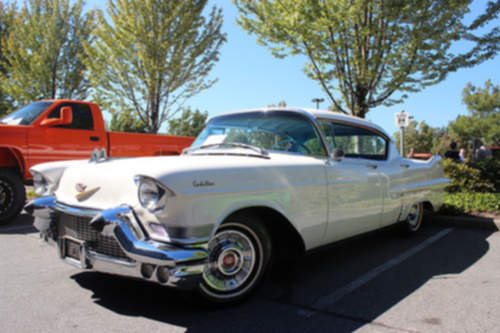
The true postwar design history at Cadillac begins with the development of the 1948 model. As World War II drew to a close, there was a climate at Cadillac which had never existed before. Forces of unrest were afoot and a couple of key people, who might otherwise be relied upon to make important decisions, weren't even there.
The 1948-49 Cadillac was a dream come true -- the dream of a young boy way back in 1920. Years before that, the boy's Detroit socialite mother, Clara, had purchased the third Cadillac ever built, in 1903. Henry Leland, the husband of Clara's close friend and founder of Cadillac, had loaned his own chauffeur to teach her how to drive. Since that time, there had been a long succession of new Cadillacs in the woman's life. The boy had thus literally grown up with Cadillacs.

1948 Cadillac convertible
But there was something about Clara's 1918 phaeton that awakened in the boy a deep appreciation for a well-designed machine. When his mother sold the phaeton after moving to California, the boy was heartbroken. He began making sketches of it, and from there expanded into the creation of his own automobile designs. Promising himself that one day he would design a Cadillac, that boy grew up to be one of the most influential automobile designers of all time: Franklin Q. Hershey.

1948 Cadillac 2-door
Hershey was initiated into the profession of automotive design at the
Walter M. Murphy Body Company in Beverly Hills, California, where he
created special automobile bodies for movie stars and millionaires. Later,
he settled into a position with General Motors in Detroit. There, he
developed a Bentley-style radiator for Pontiac, which quickly gained
Hershey the recognition and support of Harley Earl, GM's design czar.
That was followed by the famed Silver Streak Pontiacs -- a design theme
that pulled the marque out of its commercial doldrums and became its
trademark for two decades.

Click to supersize
1948 Cadillac 2-door fastback
Upon his return from a stint in Germany, where he worked with GM's Opel Division, Hershey was made head of the General Motors Advanced Design Studio at 40 Milwaukee Avenue in Detroit.
One day in the late Thirties, Earl received government permission
through a friend to take some of his best designers to Michigan's Selfridge
Field to see a secret military aircraft. Designers Bill Mitchell and Frank
Hershey were among the group. Though no one knew it then, this field trip
was destined to become legendary in the history of automotive design.
There on the runway, sat the thirteenth Lockheed P-38 Lightning, the twin-boomed aeronautical marvel that after some further development was going to set combat records in the coming war. Its radical design opened Mitchell's, and especially Hershey's, eyes to possibilities unthought of before -- they were transfixed by the elegance of the plane's design.
When the story of the '48 Cadillac is told, the influence of the plane's tailfins is usually the predominant theme. However the effect of the plane's design encompassed much more than that. Mitchell said, "You have to understand the value of what we saw in that plane's design. We saw that you could take one line and continue it from the cowl all the way back to the tip of the tail -- that you could have one unbroken, flowing line."
Hershey was also impressed with the plane's aerodynamic flow, but when he got back to his studio he began experimenting with the line of the tailfin he had seen. He worked with that idea, but both he and Mitchell moved on to other design projects before they left GM to serve in the Navy during World War II. Even so, meeting up with the P-38 Lightning had cast a spell over all the designers who had seen it. This spell would carry through the long war to the introduction of the 1948 Cadillac almost a decade later -- and beyond that into defining the design "flavor" of Cadillacs for years thereafter.
Hall Hibbard and Kelly Johnson, the designers of the plane German
fighter pilots would later label der Gabelschwanz -- the fork-tailed
devil -- were quite modest about their influential design. The plane had
evolved into its form because it had to accommodate two liquid-cooled GM
Allison engines each with a General Electric turbocharger and Prestone
radiators. Johnson was quoted in historian Bill Yenne's book on Lockheed
that, "There was a reason for everything that went into it, a logical
evolution. The shape took care of itself. In design, you are forced to
develop unusual solutions to unusual problems." In other words, the plane's
design followed the functional requirements the military had laid down to
the designers. It is one of those interesting ironies of history that Cadillac
Motor Division manufactured precision assemblies for the Allison engines
used on the P-38 during the war. Cadillac even made limited use of this
fact in its wartime advertising.
Hershey returned to GM in 1944, and Earl put him in charge of the
Cadillac Design Studio. The war was winding down, so Cadillac had to be
made ready for a return to non-military production. To set the record
straight, Mitchell, who had headed Cadillac design before going into the
military, didn't leave the Navy until about a year after Hershey. Even then,
he didn't stay long at GM because he was asked to run a private design
firm that Harley Earl had earlier started with his sons. Both the 1948 and
'49 Cadillacs had been designed before Mitchell eventually returned to GM.
One other point must be made before continuing this story. In the late
'30s, Earl had traveled the 40 miles to the University of Michigan in Ann
Arbor to get a question answered. He wondered just what would be the
optimum size for a less-than-full-size clay model of an automobile. Earl's
motivation was to save time, money, and space -- but at the same time
have his designers produce models that would give a true idea of a design
concept's full-size appearance. The University's answer, after looking into
the matter, was 3/8-scale.
... (continued on Page two)