
On a summer day in 1904 a young man by the name of William Brush helped bring about the modern automobile suspension system. Driving his brother Alanson's Crestmobile, Brush was rolling along too fast for the unpaved roads of the day and went into a curve at 30 mph. The car's right front wheel skittered onto the dirt shoulder and whammed into a deep rut. Almost at once, the wheel started to shimmy violently. The undulations of the jarred right front elliptic leaf spring had sent shock waves across the solid I-beam axle to the left side of the vehicle. This set the entire front of the car to vibrating furiously. Brush was caught unawares and lost control. The car crashed through a barbed-wire fence, hit a ditch and overturned in a cow pasture.
Several hours later young William 'fessed up to Alanson, whose demeanor switched from stern to thoughtful, since he was trying to design a better car. That car, dubbed the Brush Two-Seat Runabout, finally appeared in 1906. It featured a revolutionary suspension system that incorporated two innovations never before assembled together: front coil springs and devices at each wheel that dampened spring bounce -- shock absorbers -- mounted on a flexible hickory axle.
Some European car makers had tried coil springs, with Gottlieb Daimler in Germany being the leading exponent. However, most manufacturers stood fast with leaf springs. They were less costly, and by simply adding leaves or changing the shape from full elliptic to three-quarter or half elliptic, the spring could be made to support varying weights.
Leaf springs in one form or another have been used since the Romans suspended a two-wheeled vehicle called a Pilentum on elastic wooden poles. The first steel spring put on a vehicle was a single flat plate installed on carriages by the French in the 18th century.
The venerable leaf spring, which some manufacturers still use in rear suspensions today, was invented by Obadiah Elliot of London in 1804. He simply piled one steel plate on top of another, pinned them together and shackled each end to a carriage.
The coil spring is not a spring chicken, either. The first patent for such a spring (British patent No. 792) was issued to R. Tredwell in 1763. The main advantage of coil springs was that they did not have to be spread apart and lubricated periodically to keep them from squeaking, as leaf springs did.
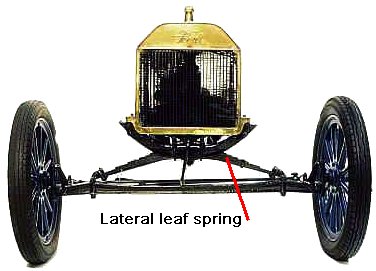
Model T Ford leaf spring
Henry Ford's 1908 Model T Ford featured old-fashioned leaf springs with a novel twist -- he used only one spring at each axle, mounted transversely, instead of one at each wheel. Ford's adaptation of high-strength vanadium steel from a French racing car allowed him to save weight and cut costs in many areas of the Model T without compromising its durability.
With the exception of a car here and there, independent coil spring front suspension remained in limbo for 25 years after the introduction of the Brush Runabout. Then suddenly in 1934, General Motors, Chrysler, Hudson, and others reintroduced coil spring front suspension, this time with each wheel sprung independently. In that year, most cars started using hydraulic shock absorbers and balloon (low-pressure) tires. Coupling a solid front axle with shock absorbers and these tires really aggravated front end shimmy. Suspending each wheel individually lessened the effects of spring bounce.
Not all cars used coil springs at first. Some had independently suspended leaf springs. But soon after World War II, all manufacturers switched to coil springs for the front wheels.
Buick became the first U.S. manufacturer to use back-end coil springs in 1938. Manufacturers have switched back and forth from model to model between leaf and coil springs since then. Generally, large, heavy cars are equipped with leaf springs, while small light cars have coil springs.
Independent rear suspension became popular on the rough, twisty roads of Europe because it can offer improved ride and handling. The cheapest method is the swing axle, for which early VWs were infamous. The differential is bolted to the frame, with constant-velocity joints on each side. However, as the wheels bounce over bumps, the tire camber and rear track change radically, causing some handling quirks. In extreme maneuvers, an outside wheel can actually tuck under the car, causing it to flip.
Axles with joints at both ends do a better job of keeping the wheels upright in a turn, and an amazing variety of control arms have been used to meet this end. Trailing arms, once popular, sometimes allowed trailing throttle oversteer -- lift your foot off the gas pedal in a turn and the rear wheels shift slightly, throwing the car into a skid. Modern designs use up to six control links at each wheel to prevent such erratic behavior as bump steer and trailing throttle oversteer.
Air suspension, which Lincoln ballyhooed for some models in 1984 was introduced in 1909 by the Cowey Motor Works of Great Britain. It did not work well because it leaked.
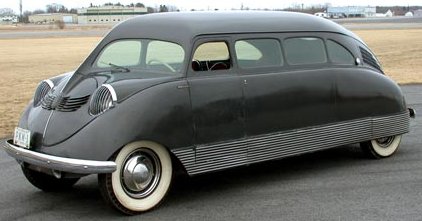
Stout-Scarab
The first practical air suspension was developed by Firestone in 1933 for an experimental car called the Stout-Scarab. This was a rear-engined vehicle that used four rubberized bellows in place of conventional springs. Air was supplied by small compressors attached to each bellow. As you might imagine, the air bag suspension was an expensive setup -- still is, in fact.
The first automobile to use torsion bar suspension was the 1921 Leyland. Most of the credit for the wide acceptance of torsion bars in Europe goes to Dr. Ferdinand Porsche who made it standard on most of his cars, beginning with the 1933 Volkswagen prototypes. By 1954, 21 makes of European cars were equipped with torsion bars.
By contrast, in America, only Chrysler went the torsion bar route on its large-sized cars. Despite its excellent ride qualities, high cost has limited its acceptance in this country.
A renowned British surgeon, who had been knighted by Queen Victoria, was convinced of a direct relationship between sound health and driving a car. Dr. William Thomson's observations were made in a 1901 edition of the Journal of Medicine where he stated:
I have found my drives to improve my general health. The jolting which occurs when a motor car is driven at fair speed conduces to healthy agitation that acts on the liver. This aids the peristaltic movements of the bowels and promotes the performance of their functions.
Manufacturers of cars either did not read Sir Thomas's report or did not care for his views, because soon afterward they began using shock absorbers to suppress vehicular jolting.
Since early motor cars were limited to much the same speed as carriages, leaf springs for them could be made of the right proportion to provide relatively jolt-free rides. As roads were improved and speeds shot up, a 1909 edition of Automobile Engineering noted:
When springs are made sufficiently stiff to carry the load properly over the small inequalities of ordinary roads, they are too stiff to respond readily to the larger bumps. The result is a shock, or jounce, to the passengers. When the springs are made lighter and more flexible in order to minimize the larger shocks, the smaller ones have too large an influence, thus keeping the [car] body and its passengers in motion all the time. These two contradictory conditions have created the field for the shock absorber.
The first recorded use of a crude shock absorber is the invention by one A. Gimmig in 1897. He attached rubber blocks to the top of each leaf spring. When the suspension was compressed sufficiently, the rubber bumpers hit bolts that were attached to the frame. Rubber bump stops are still used in many modern suspensions, but their effect on ride control is minimal.
The first true shock absorbers were fitted to a racing bicycle in 1898 by a Frenchman named J. M. M. Truffault. The front fork was suspended on springs, and incorporated a friction device that kept the bike from oscillating constantly. In 1899, an American automobile enthusiast named Edward V. Hartford saw one of Truffault's bikes win a marathon race at Versailles. Hartford immediately recognized the automotive potential of the friction device.
Hartford and Truffault got together and by the next year Hartford had outfitted an Oldsmobile with a variation of Truffault's device. This first automobile shock absorber consisted of a pair of levers that were hinged together with a pad of rubber placed at the pivot point. One of the lever arms was attached to the frame, while the other was bolted to the leaf spring.
A bolt placed at the hinge point could be tightened or loosened to increase or decrease the friction, providing a stiffer or softer ride. The Truffault-Hartford unit was, therefore, not only the first automotive shock absorber, but also the first adjustable shock.
Hartford brought the car to America, where he opened his own plant, the Hartford Suspension Co., in Jersey City, New Jersey. His first big contract came from Alanson P. Brush, who installed shock absorbers along with front coil springs on the 1906 Brush Runabout. The ride given by the car was called "magnificent" in a critique written by Hugh Dolnar for Cycle and Automobile Trade Journal.
From then on shock absorber designs came fast and furious.
This consisted of a housing that contained a belt wound into a coil. It was kept under tension by a spring. The housing was fastened to the frame and the outer end of the belt was attached to the axle to limit the degree of rebound from a jolt.
The Gabriel Co. started operation in 1906 making accessory auto horns. The founder, Claude H. Foster, named his firm after the horn-tooting angel Gabriel. When the pushbutton horn came along in 1914, it killed the Gabriel and all other body-mounted horns. Foster looked for a product to keep his company in business and came across the Snubber.
These were auxiliary coil springs used in addition to the leaf spring. Since each spring had a different harmonic frequency, they tended to cancel out one another's oscillations. But they also added to ride harshness and soon fell out of favor.
Air springs combine spring and shock absorbing action in one unit and were often used without metal springs. The first one was developed by Cowey Motor Works of Great Britain in 1909. It was a cylinder that could be filled with air from a bicycle pump through a valve in the upper part of the housing. The lower half of the cylinder contained a diaphragm made of rubber and cord which, because it was surrounded by air, acted like a pneumatic tire. Its main problem was that it often lost air.
The newest air spring, developed by Goodyear, is found on some late-model Lincolns. Like the ones that have preceded them, these ride-on-air units are more costly than conventional springs and hydraulic shock absorbers.
M. Houdaille of France gets credit for designing the first workable hydraulic shock absorber in 1908. Hydraulic shocks damp spring oscillations by forcing fluid through small passages. In the popular tubular shock, a piston with small orifices is attached to the chassis and a cylindrical oil reservoir is attached to the suspension or axle. As the suspension moves up and down, the piston is forced through the oil, resisting the action of the spring.
One-way valves allow different orifices to be used to control suspension jounce and rebound. This is called a double-acting shock. The latest wrinkle is to add a chamber of compressible gas at one end of the fluid reservoir to cushion the damping action.
Monroe built the first original equipment hydraulic shocks for Hudson in 1933. By the late 1930s the double-acting tubular shock absorber became common on cars made in the United States. In Europe, lever-type hydraulic shocks prevailed into the '60s. They resembled the Hartford friction shock, but used hydraulic fluid instead of a friction pad.
With the advent of front-wheel-drive cars, manufacturers in the 1970s and '80s started using MacPherson struts. MacPherson, a GM engineer, developed this unit in the 1960s. It combines the coil spring, hydraulic shock absorber, and upper suspension arm into a single compact device. The main advantage is that it allows the necessary space for positioning the front-drive transaxle.
Several Japanese cars now feature struts with shock valving that can be adjusted from soft to firm by electric motors while the car is moving. The driver has a choice of three settings, but a signal from the speedometer usually overrides the manual control at highway speeds to set the shocks on firm.
The Nissan Maxima for 1985 sold in Japan had electronically controlled shocks that automatically provided a soft, medium, or firm ride depending upon road conditions, speed, and driving style. A sonar unit under the bumper monitored the road surface, while other sensors checked speed, acceleration, steering angle, and brake use.
Data were fed to a central processing unit that decided if you were driving gently or aggressively, then activated shafts in the shock absorbers that altered the size of fluid passages.
The Lotus Active Suspension System does away with springs and shock absorbers altogether. Eighteen motion sensing transducers send data to four computer-controlled hydraulic rams. The system distinguishes roll, dive, jounce, and bump. Valves in the rams adjust the ride accordingly. These valves can change position as much as 250 times per second.
The Lotus system has the uncanny ability to keep a car level in a tight turn or even bank it toward the inside of the turn, rather than leaning to the outside as other cars do.