
- Fuel
-
- Any material substance that can be consumed to supply heat or power. Included are petroleum (gasoline and diesel), coal, and natural gas (CNG, LPG), and other consumable materials, such as uranium, biomass, and hydrogen.
- A material used to create heat or power through chemical conversion in processes such as burning or electrochemistry.
- A combustible material used to produce energy. One of the essential factors in a Combustion engine (Fuel, Air, Proper proportion of mixture, compression, timing, spark).
See- Air And Fuel
- air-fuel ratio
- Alcohol Fuel
- Alternative Fuel
- Aviation fuel
- Boiler Fuel
- Bunker Fuels
- Ceramic Fuel
- Clean Fuel
- Deceleration fuel cut-off
- Diesel fuel
- Domestic Fuel
- Early fuel evaporation system
- Electric fuel pump
- Electronic fuel injection
- EPA fuel economy
- in-line fuel filter
- Injection Fuel
- integral fuel filter
- Jet Fuel
- Kerosene Jet Fuel
- L-jetronic fuel injection system
- Low fuel indicator
- Low Sulfur Diesel Fuel
- Naphtha-Type Jet Fuel
- Near Neat Fuel
- Neat Alcohol Fuel
- Neat Fuel
- Nonrenewable Fuels
- Number One Diesel Fuel
- Number Two Diesel Fuel
- Oxygenated Fuel
- Petroleum Fuel
- Port fuel injection
- Primary Fuels
- Process Fuel
- Proper proportion of air and fuel
- Refinery Fuel
- Temporarily Discharged Fuel
- Ultra-Low Sulfur Diesel Fuel
- Fuel accumulator
-
- A device in the K-Jetronicfuel injection system which serves to absorb the initial pressure surge when a fuel pump starts
- A diaphragm unit which helps maintain residual fuel pressure for hot starting on CIS type fuel system
- Fuel additive
- A chemical preparation which is added to fuel to improve and maintain its properties. Detergents and corrosion inhibitors are examples of gasoline additives.
- Fuel advance system
- Advances fuel delivery during cold starts on GM vehicle. Consists of a thermal-sensitive Solenoid on the intake manifold which sends a signal to the HPCA terminal, which opens a ball-check valve on top of the injection pump housing. With pump housing pressure reduced, the timing mechanism has less resistance to overcome and operates earlier, advancing fuel delivery 3 degrees
- Fuel-air mixture
-
- A combination of Vaporized fuel and air which is brought into the cylinder through the carburetor or fuel injectors. When it is compressed and ignited, it produces the power needed to drive the engine.
- A mist consisting of fuel and air that's compressed in the cylinders and ignited to drive the pistons in a car's engine.
- Fuel-air ratio
- The amount of fuel in comparison with the amount of air. This is the reciprocal of the air-fuel ratio.
- Fuel burner
- Competition vehicle with an engine set up to burn alcohol, nitro, etc. mixture instead of standard pump gasoline. Also called fueller.
- Fuel cap
-
A vented covering on the top of the tube leading to the fuel tank. Also called gas cap.
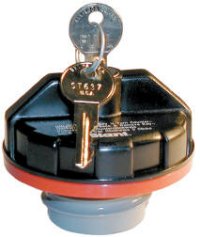
Fuel cap
- Fuel cell
-
- A galvanic cell in which the oxidation of a fuel (e.g., methanol) is used to produce electricity.
- A cell that converts chemical energy directly into electric energy, with electric power being produced as part of a chemical reaction between the electrolyte and a fuel such as kerosene or industrial fuel gas.
- An electrochemical power plant (no moving parts) that creates electrical current from hydrogen and oxygen that is passed over a catalyst, usually a microscopically thin sheet of platinum. The electrical current is then fed directly to an electric motor for propulsion. Fuel cells differ from conventional electrical cells in that the active materials such as fuel and oxygen are not contained within the cell but are supplied from outside. It does not contain an intermediate heat cycle, as do most other electrical generation techniques. The only by product of a fuel cell's operation is water, which is pure enough to drink. These cells were first used by NASA in the 1960's for power generation in space capsules. The high price of fuel cell technology has limited the growth of their implementation, but now cells are being used to generate power in hospitals, and to propel vehicles.
- Fuel cock
- A tap which can allow or restrict the flow of gasoline from the gas tank to the carburetor. An essential item on a motorcycle with gravity fed fuel (i.e., no fuel pump) because if the fuel cock is left on after the engine is shut down, there is the possibility that gasoline could leak past the Needle and seat in the carburetor so that the overflow in the float bowl will make its way into the cylinder and wash the walls and dilute the oil
- Fuel computer
- A device which continuously displays the amount of fuel used over the distance since last set.
- Fuel consumption
- The amount of fuel used, expressed in miles per gallon in Britain and the USA, whereas the international measure is litres per 100 kilometres. The US term is fuel mileage.
- Fuel consumption indicator
- An instrument using a Flowmeter to indicate mpg or litres/100 km at any given moment on a journey
- Fuel Control
- Device designed to regulate the fuel supply to the controlled equipment. These may be manual, semi-automatic or automatic.
- Fuel cycle
- The entire set of sequential processes or stages involved in the utilization of fuel, including extraction in its native form, transformation (converting it to a useful product), transportation to market, and combustion (i.e., consuming it at its final destination). Emissions generally occur at each stage of the fuel cycle.
- Fuel distributor
-
- A device constituting the mixture control unit together with the airflow sensor.
- On Bosch CIS, the device that supplies the injection with pressurized fuel in proportion to air volume, measured by the airflow sensor plate. The fuel distributor houses the control plunger and the differential-pressure valves. All fuel metering takes place inside the fuel distributor
- The component which feeds fuel to the individual engine cylinders corresponding to the air flow rate metered by the air flow sensor on CIS system
- Fuel economy
- The number of litres used per 100 kilometres of driving (a lower number is better); or the number of miles driven divided by the number of gallons used (a higher number is better).
- Fuel efficiency
- Although this factor is similar to fuel economy, it differs in that fuel efficiency involves getting the most amount of energy from an amount of fuel. It answers the question, 'What percent of the fuel does this engine burn?'
- Fuel ethanol
- (C2H5OH) An anhydrous alcohol (ethanol with less than 1% water) intended for gasoline blending as described in the Oxygenates definition.
- Fuel filler flap
- A piece of rubber about 4' square and very thin, which is located behind the filler door. When the door is opened, the flap falls down to protect the body from the fuel nozzle.
- Fuel filler neck
- The upper end of the fuel filler tube leading down to the fuel tank, which accepts the fuel hose nozzle at the Gas station
- Fuel filter
-
A device that removes impurities (dirt and water) from the fuel before it gets to the carburetor or injection system. Filters may be made of metal or plastic screen, paper, or gauze. They are usually found near the carburetor in the fuel line that comes from the fuel pump (in-line fuel filter), or inside the carburetor (integral fuel filter) or within the fuel pump or fuel tank. These units must be cleaned or replaced on a regular basis, usually once a year or they will become clogged and restrict fuel to the carburetor. Without a filter, the jets and orifices in the carburetor will become clogged.
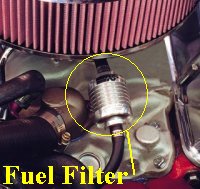
Fuel filter
- Fuel gas compressor
- A pump or machine for reducing the volume and increasing the pressure of fuel gas.
- Fuel gauge
- An instrument, usually located on the dashboard or center console, which indicates the amount of fuel in the fuel tank. Most gauges have a Needle which fluctuates between E (empty) and F (full). Others show a digital readout of how many gallons or litres left in the tank. Also called gas gauge.
- Fuel-injected engine
- A gasoline engine with a fuel injection system rather than a carburetor.
- Fuel injection
-
(FI) A fuel system that uses no carburetor but sprays fuel either directly into the cylinders or into the intake manifold just ahead of the cylinders. It uses an electronic sensing device to deliver the correct amount into the combustion chamber. Throttle-body injection locates the injector(s) centrally in the throttle-body housing, while Port injection allocates at least one injector for each cylinder near its Intake port.
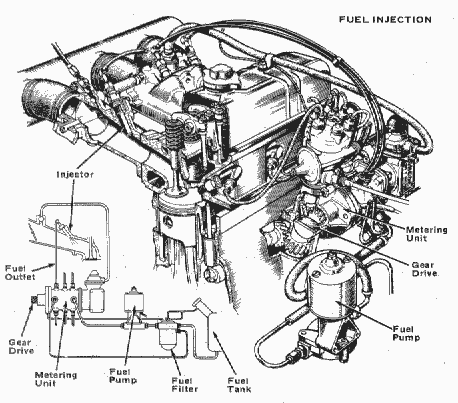
Fuel Injection System
- Fuel injection pump
-
- A pump which receives fuel from the fuel tank (often through the fuel-feed pump in the case of diesel engines) and delivers it under pressure to the injectors
- A pump on diesel engines that sends fuel to its mini-pumps, and from there to the fuel injector nozzles.
- Fuel injector
-
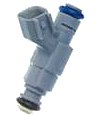
Fuel injector
- A special nozzle which sprays the proper amount of gasoline or diesel fuel into the inlet ports, either directly into the combustion chamber or into a pre-chamber in response to signals from an electronic sensing device.
- In all fuel-injection system (except Bosch CIS, CIS/Lambda, and CIS-E systems), a spring loaded, Solenoid (electromagnetic) valve which delivers fuel into the intake manifold, in response to electrical signals from the control module in the CIS, etc. System, the injector is simply a spring-loaded, pressure sensitive valve which opens at a preset value
- Fuel injector nozzle
- The device that works like a hypodermic Needle to inject the proper amount of fuel into the combustion chamber in response to signals from an electronic sensing device on cars with fuel injection systems. It receive fuel at low pressure and shoot it into the engine cylinders at predetermined intervals under higher pressure. Also called fuel injector valve or just fuel injector.
- Fuel line
- The metal, plastic, or rubber hose or pipe through which the fuel passes from the fuel tank to the fuel pump to the carburetor or fuel injector nozzle.
- Fuel metering sensor
-
A motor detection device on a carburetor which closes or opens a fuel-metering port to regulate fuel mixture, keeping the air-fuel ratio at exactly 14.61 (stoichiometric) at all times.

Fuel metering sensor
- Fuel mileage
- A measurement or calculation of the number of miles per amount of fuel -- usually measured in miles per gallon.
- Fuel mixture
- A mixture of gasoline and air. An average mixture, by weight, would contain 16 parts of air to one part of gasoline.
- Fuel oil
-
- Kerosene or any hydrocarbon oil as specified by U.S. Department of Commerce Commercial Standard CS1 2 or ASTM D296, or the Canadian Government Specification Board, 3-GP-28, and having a flash point not less than 38°C.
- A liquid petroleum product less volatile than gasoline, used as an energy source. Fuel oil includes distillate fuel oil (No. 1, No. 2, and No. 4), and residual fuel oil (No. 5 and No. 6).
- The heavy distillates from the oil refining process; used as fuel for power stations and marine boilers.
- Fuel oil types
- There are several designated types of fuel oil such as:
- No. 1 diesel fuel: A light distillate fuel oil that has a distillation temperature of 288°C at the 90-percent recovery point and meets the specifications defined in ASTM Specification D 975. It is used in high speed diesel engines generally operated under frequent speed and load changes, such as those in city buses and similar vehicles. See No. 1 distillate below.
- No. 1 distillate: A light petroleum distillate that can be used as either a diesel fuel: (see No. 1 diesel fuel above) or a fuel oil: (see No. 1 fuel oil: (below).
- No. 1 fuel oil: A light distillate fuel oil that has distillation temperatures of 204°C at the 10-percent recovery point and 288°C at the 90-percent recovery point and meets the specifications defined in ASTM Specification D 396. It is used primarily as fuel for portable outdoor stoves and portable outdoor heaters. See No. 1 Distillate above.
- No. 2 diesel fuel: A distillate fuel oil that has a distillation temperature of 338°C at the 90-percent recovery point and meets the specifications defined in ASTM Specification D 975. It is used in high-speed diesel engines that are generally operated under uniform speed and load conditions, such as those in railroad locomotives, trucks, and automobiles. See No. 2 Distillate below.
- No. 2 distillate: A petroleum distillate that can be used as either a diesel fuel: (see No. 2 diesel fuel above) or a fuel oil: (see No. 2 fuel oil below).
- No. 2 fuel oil: (heating oil) A distillate fuel oil that has a distillation temperature of 338°C at the 90-percent recovery point and meets the specifications defined in ASTM Specification D 396. It is used in atomizing type burners for domestic heating or for moderate capacity commercial/industrial burner units. See No. 2 Distillate above.
- No. 2 fuel oil and No. 2 diesel sold to consumers for all other end uses: Those consumers who purchase fuel oil or diesel fuel for their own use including: commercial/institutional buildings: (including apartment buildings), manufacturing and nonmanufacturing establishments, farms: (including farm houses), motor vehicles, commercial or private boats, military, governments, electric utilities, railroads, construction, logging or any other nonresidential end-use purpose.
- No. 2 fuel oil sold to private homes for heating: Private household customers who purchase fuel oil for the specific purpose of heating their home, water heating, cooking, etc., excluding farm houses, farming and apartment buildings.
- No. 4 fuel oil: A distillate fuel oil made by blending distillate fuel oil and residual fuel oil stocks. It conforms with ASTM Specification D 396 or Federal Specification VV-F-815C and is used extensively in industrial plants and in commercial burner installations that are not equipped with preheating facilities. It also includes No. 4 diesel fuel used for low- and medium-speed diesel engines and conforms to ASTM Specification D 975.
- No. 5 and no. 6 fuel oil sold directly to the ultimate consumer: Includes ships, mines, smelters, manufacturing plants, electric utilities, drilling, railroad.
- No. 5 and no. 6 fuel oil sold to refiners or other dealers who will resale the product: Includes all volumes of No. 5 and No. 6 fuel oil purchased by a trade or business with the intent of reselling the product to the ultimate consumers.
- Fuel petcock
- An on-off valve located at the bottom of a motorcycle fuel tank. It may have a filter screen and sediment bowl and sometimes provides a reserve fuel supply.
- Fuel pressure
- The pressure under which fuel is delivered to the injectors by the fuel pump, governed by the pressure regulator
- Fuel pressure regulator
-
A spring-loaded pressure-activated diaphragm valve that maintains the pressure in a fuel system to a pre-set value above manifold pressure, particularly in a fuel injection system and meters unused fuel back to the fuel tank.

Fuel pressure regulator
- Fuel pump
- A vacuum device, operated either mechanically or electrically, that is used to draw gasoline from the tank and sends it into the carburetor or fuel injector nozzles. Mechanical pumps have a Rocker arm that is activated by a cam on the camshaft; the arm causes a diaphragm to move up and down, thus pulling the gas through the pump. Some electrical pumps have a rocker arm which is activated electrically and does the same thing as the mechanical pump. Other electrical pumps are located at the bottom of the fuel tank and push the fuel through the fuel lines.
- Fuel pump filter
-
-
A filter screen built into the fuel pump itself as used on VW Beetles with a mechanical fuel pump.

VW Fuel pump filter
-
A screw-on canister holding a replaceable pleated paper filter. The canister is mounted onto the base of a fuel pump

screw-on fuel pump filter
-
- Fuel pump relay
- An electric switch which activates the fuel pump when the engine is cranked and when the engine is running.
- Fuel pump shut-off switch
- A switch which shuts off the electric fuel pump and fuel to the engine in the event of a major collision
- Fuel pump switch
- A switch which shuts off the electric fuel pump and fuel to the engine in the event of a major collision
- Fuel rail
- A manifold tube feeding the injectors in a fuel injection system. A special manifold designed to provide a large reservoir of pressurized fuel for the fuel injectors, which are attached between the rail and the intake runners or the cylinder head. The fuel rail also serves as a mounting place for the fuel damper (if equipped) and the fuel pressure regulator
- Fuel return line
- A pipe returning surplus fuel to the tank from the carburetor(s) or to the inlet side of the injector pump
- Fuels solvent deasphalting
- A refining process for removing asphalt compounds from petroleum fractions, such as reduced crude oil. The recovered stream from this process is used to produce fuel products.
- Fuel stabilizer
- A chemical which is added to gasoline to prevent it from becoming stale. Gasoline, diesel, or heating fuel reacts with oxygen in the atmosphere and leave behind a varnish-like film or gum residue. While some fuel contains an oxidation inhibitor which allows it to be stored for up to three months, other fuels don't have this inhibitor. Stale gasoline can clog fuel lines, carburetors, and injectors. A good fuel stabilizer can lengthen fuel's useful life.
- Fuel starvation
- The failure of the fuel system to supply sufficient fuel to allow the engine to run properly, due to a blockage or vapor lock or malfunction of the fuel pump.
- Fuel supply
- The delivery of fuel to the carburetor or injection system
- Fuel system
- A system that stores, cleans, and delivers the fuel to the engine in proper quantities to meet the varying needs that arise as you drive. It is made up of the fuel tank, fuel lines, fuel pump, fuel filter, and carburetor or the fuel injection system.
- Fuel tank
-
The storage compartment, under the trunk in most cars, that holds the fuel for the vehicle. Also called the gas tank.

Fuel tank
- Fuel tank sender
- A level sensor in the gas tank which sends information about the amount of remaining fuel.
- Fuel tank vapor valve
- A valve mounted in the top of the fuel tank. Vents excess vapor and pressure from the fuel tank into the evaporative emission control system
- Fuel utilization
- In fuel cells, the fraction of the fuel or oxidant that enters the cell that reacts electrochemically.
- Fuel-vacuum separator
- Used to filter waxy hydrocarbons from the carburetor ported vacuum to protect the vacuum delay and distributor vacuum controls
- Fuel vapor
-
- Atomized air/fuel mixture heated in the engine, ready for combustion
- Fumes given off by gasoline
- Fuel vapor recirculation system
- An emission system which traps the excess gasoline vapor, condenses it back to liquid form, and then sends it back to the gasoline tank. Also called evaporative emission control system
- Fuel vapor recovery system
- (FVR) a valve responsible for venting excess fuel vapor and pressure from the fuel system to the EEC system
- Fugitive emissions
- Unintended leaks of gas from the processing, transmission, and/or transportation of fossil fuels.
- Fulcrum pin
- A pin which acts as a pivot, such as a kingpin
- Fulcrum ring
-
One of two rings on either side of a Clutch diaphragm spring on which it pivots.

Fulcrum ring
See
- Full Annealing
- Annealing a ferrous alloy by austenitizing and then cooling slowly through the transformation range.
- Full body diameter
- A screw or bolt where the shoulder diameter is the same as the outside or major diameter of the threaded portion.
- Full bore
-
- A term expressing top speed or full throttle.
- A colloquial term used by vehicle salesmen to express the sale of a vehicle for the full sticker price with no discount.
- Full cam
- A type of camshaft for race car engines which increases lift of valve, speed of valve opening and closing, length of time valve is held open, etc. Also called Race cam, Three-quarter cam, or Semi-race cam, depending upon design
- Full cap
- A condition of retreading where new tread rubber is added to the buffed Casing, and covers the crown and shoulder areas.
- Full Coverage Auto Insurance
- An insurance coverage that includes liability, collision and a comprehensive insurance policy. Here is an informative guide.
- Full-Depth Reclamation
- A special recycling machine grinds up the roadway, up to 6-10' deep, and produces a recycled granular base layer, usually incorporating a liquid asphalt emulsion binder. This layer is then paved with one or more layers of asphalt concrete. The finished driving surface could be an asphalt concrete 'top mix' or a surface treatment. Since this type of work involves up to three or four layers that often require 'curing,' it is usually spread over an 8-12 week period.
- Full dip treatment
- A painting process in which the whole body shell is immersed, used for applying protective Primers
- Full floating
- Mechanism construction in which a shaft is free to turn in all parts in which it is inserted
- Full-floating axle
- A rear drive axle that does not hold the wheel on nor does it hold the wheel in line
or support any weight. It merely drives the wheel. Used primarily on racing cars and
trucks.
See
- Full-flow oil filter
- An Oil filter that filters all of the oil passing through the engine before it reaches the bearings.
- Full leather
- A car interior in which the door trim, instrument panel, seats are covered in leather
- Full leather upholstery
- A car interior in which the door trim, instrument panel, seats are covered in leather
- Full load
- An engine operating conditions where the accelerator is fully depressed, i.e., the
throttle is fully open, which does not necessarily mean high engine speed
See
- Full-load current
- The current drawn from the line when the electric motor is operating at full-load torque and full-load speed at rated frequency and voltage
- Full load enrichment
- The provision of a richer mixture when the throttle is fully opened. On some system, the computer goes open-loop during full-load enrichment
- Full load torque
-
- Maximum torque delivered without overheating.
- The torque necessary to produce the rated horsepower at full-load speed
- Full lock
-
- A condition in which a detachable component (e.g., seat belt buckles) is securely attached.
- The maximum angle attained by the wheels when the steering wheel is turned to its full extent
- Full panel
- A body part that may be made up of several other subassemblies and is fairly complex and cumbersome, e.g., a complete bulkhead assembly incorporating the windshield pillars
- Full respray
- Painting the entire component or entire vehicle as opposed to a partial respray
- Full service history
- (fsh) The documents which show all the work performed on a vehicle, especially the regular service required by the manufacturer
- Full-Size Body
- The body of a bolt or screw which has a diameter between the minimum and maximum limits of the major diameter of the thread.
- Full-size car
- The largest type of car according to the American system. It is a designation no longer used because even full-size cars are now about the size of what was the compact car. In 1970, for instance, a Chevrolet Impala was a full-size car, a Chevelle was an intermediate, and a Nova was a compact. When cars smaller than the Nova came out (i.e., Chevette), they were called sub-compacts.
- Full-size spare
- A spare wheel and tire combination which is the same size as the rest of the wheels. Compare Space saver spare
- Full-skirt piston
- A former piston style which had a full-annulus skirt, without the cutaway section of modern Slipper pistons
- Full sun
- The full sun condition is the amount of power density received at the surface of the earth at noon on a clear day -- about 1.0 kilowatt/square-metre. Lower levels of sunlight are often expressed as 0.5 sun or 0.1 sun. A figure of 0.5 sun means that the power density of the sunlight is one-half of that of a full sun.
- Full-time 4x4
- A transmission system on a four-wheeled vehicle in which all four wheels are driven by the engine all the time. Other four-wheel drive units are normally in two-wheel drive mode with four-wheel drive selected by a separate lever when required.
- Full-time four-wheel drive
- A condition where all four wheels are always being driven by the drivetrain. It may include the option of part-time (that is, shifting into 2WD for dry pavement) operation, and may or may not have Hi and Lo 4WD speed ranges. The British term is permanent four-wheel drive.
- Full trailer
- A trailer with axles in the front as well as the rear. It can stand without support. Full trailers are coupled to straight trucks and to the rear of semi or full trailers by a tongue or drawbar. Full trailers are seldom used alone with tractors.
- Full Truckload
- A shipment comprising a full or almost full load on a truck. A full or almost full load is considered to be 39,000 to 44,000 pounds.
- Full-wave rectifier
- A rectifier that converts ac to dc by inverting the negative portion of an ac sine wave.
See
- Fully electronic ignition
- (FEI) A distributorless, mapped ignition system with cylinder-selective knock control, dwell-angle control, and digital idling speed stabilization
- Fully floating axle
- A live rear axle assembly in which the axle shafts serve only to transmit torque to the wheel. The total vehicle weight and cornering loads are transferred directly from the wheel bearings to the axle housing.
- Fully galvanized body
- A body shell which, except for aluminum and plastic parts, is produced entirely of double-sided galvanized steel and galvanized fasteners or which is immersed in galvanizing fluid
- Functional
-
- Capable of working even if it is not working to its peak performance.
- Practical, designed not for esthetics; but solely with a particular use in mind
- Funnel
-
- A cup-shaped object tapering at the bottom to a small hole and a spout, used for pouring oil, fuel, or water into relatively small openings
- A smokestack of a vessel.
- Funny car
- A car equipped with a powerful engine, used for drag racing. Usually has special body (such as Fibreglass) mounted on special lightweight frame and Suspension system.
- Furnace
-
- A heater or large forge for heating plates or shapes for bending
- To bend by heating in furnace.
- Furnace, central warm air
- Self-contained appliance designed to supply heated air through ducts to spaces remote from or adjacent to the appliance location.
- Fuse
-
- A protective electrical device (usually enclosed in glass or plastic) which has a thin wire between two terminals. The wire will break or melt when the current draw exceeds the capacity of the fuse. In this way, the circuit is protected from overload.
- The action of melting when a piece of metal turns to a liquid state and sometimes unites itself to a nearby component.
- A failure of an electrical component because of a blown fuse.
- Fuse box
- A container with a removable cover that holds the fuses for the various electrical circuits, which are all routed through it
- Fuse capacity
-
See
- fuse.
- Fusible link
-
- Special length of smaller gauge wire designed to blow if heavy current flows in circuit
- A wire in the electrical system which outwardly may appear to be no different from other wires, but has a low resistance level so that when the current is above a certain level, the wire melts and breaks continuity.
- Fusible plug
- Plug or fitting made with a metal of a known low-melting temperature. Used as safety device to release pressures in case of fire.
- Fusion fit
- The Adjustable Retention System extending behind a Bell bicycle helmets to allow the helmet to grip your head better.