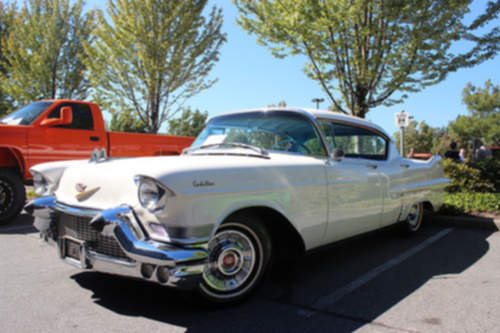
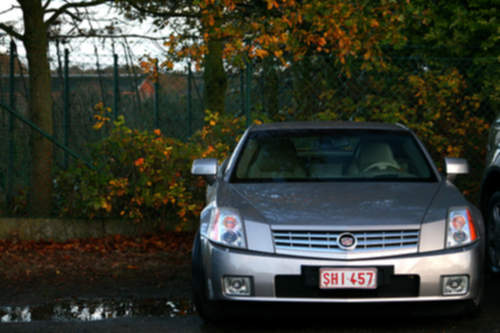
"Best of all . . . it's a Cadillac," declared the 1982 full-line catalog. Perhaps so, but long-time Caddy fans must have been startled by the company's latest offering: the four-cylinder Cimarron, with manual floor shift yet. Introduced several years earlier than originally planned, this drastically different breed of luxury was intended to give Cadillac a toehold in the rising market for smaller, fuel-efficient designs.
On all except Cimarron, a new lightweight Cadillac 249 cu. in. (4.1 liter) HT-4100 V-8 engine with Digital Fuel Injection (DFI) became standard, coupled to overdrive automatic transmission. The Oldsmobile-built diesel 5.7-liter V-8 was also available. So was a Buick 4.1-liter V-6, offered as a credit option.
A new Fuel Data Panel (standard with the HT-4100 engine) displayed instantaneous MPG, average MPG, estimated driving range, and amount of fuel used. Electronic Climate Control had a new outside temperature display, available by touching a button. New reminder chimes used different tone patterns to warn of unbuckled seatbelts, headlamps left on, or key in ignition.
Body mounts, springs and shocks were revised to give a softer ride. All Cadillacs except Cimarron had standard
All except Seville with cloth interior had front seatback map pockets. New to the full-size option list was a remote-locking fuel filler door. The HT-4100 V-8 engine had an aluminum block for light weight and chrome-plated valve covers for looks. During manufacture, it received individually balanced components and automatic in-process gauging, and had to pass a 78-step "stress test" before installation. Features added to improve fuel economy included fast-burn compact combustion chambers, digital fuel injection, and bearings designed for low-drag lubricants.
Standard with the HT-4100 engine was four-speed overdrive automatic transmission, helping to improve mileage further. EPA estimates reached 26 highway/17 city for Fleetwood/DeVille models, 27 highway for Seville/Eldorado. A Fuel Data Panel computed average MPG on the road. On-board computer diagnostics warned of engine problems and helped the mechanic locate the trouble quickly. The digital fuel injection included automatic altitude compensation, determined by a microprocessor, plus constant idle speed. The HT-4100 replaced the troublesome V8-6-4 modular-displacement engine, helping to boost both gas mileage and sales. That new engine was installed in some 90 percent of Sevilles, DeVilles and Eldorados. An HT-4100 nameplate went on front fenders of all models with that engine under the hood.
| All Cadillacs again had a 17-symbol Vehicle Identification Number (VIN), stamped on a metal tag attached to the upper left surface of the cowl, visible through the windshield. Coding was similar to 1981-82. |
| The number begins with a "1" to indicate the manufacturing country (U.S.A.), followed by a "G" for General Motors and a "6" for Cadillac Division. |
The next letter indicates restraint system:
|
Symbol five is a letter denoting car line and series:
|
Digits six and seven indicate body type:
|
Next comes an engine code:
|
| The next symbol is a check digit. |
| Symbol ten indicates model year ("C" 1982). |
Symbol eleven denotes assembly plant:
|
| The final six-digit production sequence number began with 100001 for Detroit-built models: 600001 (Eldorado) or 680001 (Seville) for those built in New Jersey. |
| An identification number for the V-6 engine was on the left rear of the block; on the V8-350, a code label was on top of the left valve cover and a unit number label atop the right valve cover. |
| Other engines had a unit number on the block behind the left cylinder head, and a VIN derivative on the block behind the intake manifold. |
| A body number plate on the upper horizontal surface of the shroud (except Seville, on front vertical shroud surface) showed model year, build date code, car division, series, style, body assembly plant, body number, trim combination, paint code, modular seat code, and roof option. |