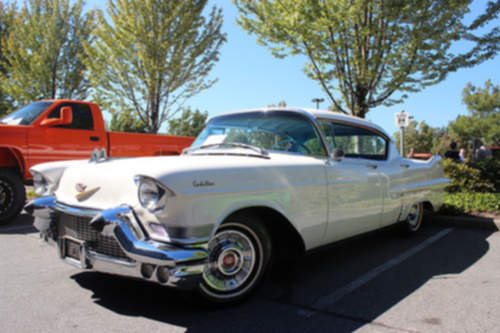
Cadillac tempered its outlandish fins for 1960, the year that marked the division's last use of triple two-barrel carburetion as standard Eldorado issue. For the remaining six years of its production life the rear-drive Eldo would have the same engine specs as its less exotic linemates. As mentioned, air suspension was also abandoned after 1960. So was the Eldorado hardtop. With lower sales than the Biarritz for the second year in a row and with two other hardtop coupes in the Cadillac line, the Seville had by now become superfluous. So too had the Brougham, and Cadillac rang down the curtain on its super-luxury flagship after building only 200 of the 1959-60 models.
More exclusive—and more expensive—were the two-door Eldorados:
Seville coupe and Biarritz convertible. They came with a 345-horsepower
version of the 390-cid V-8 that guzzled gas through three two-barrel
carburetors. The Eldorados lost some of their exclusivity in 1959 because
they no longer sported unique rear end designs and they switched from the
"Sabre Spoke" wheels of '58 to stamped steel wheels. Nonetheless,
Eldorados sported deep-dish wheel covers (sharing them with the Sixty
Special) and fender skirts were standard, as they were for all 1959-60
Cadillacs. Air suspension was another standard item (it disappeared after
1960 because of chronic leakage problems). Also included were cruise
control, Autronic Eye headlight dimmer, radio and electric antenna, power
door locks, fog lamps, and three rows of jewels in the rear.
Distinguishing characteristics of the Seville were a color-keyed roof
covering of weather resistant fabric and unique chrome trim that started at
the vent window and followed the body contour to the rear bumper, then
proceeded down and around, following the rocker panel to the front wheel.
The Seville was dropped after 1960, although the name would be
reincarnated 15 years later on a smaller Cadillac. The Biarritz sold for the
same $7401 list price as the Seville. Its top was hidden by a metal cover
when down, giving the car a smooth, uninterrupted profile that flowed
from front to rear, ending in a dramatic upsweep of the towering fins.
Standing at the top of Cadillac's 13-model lineup was the second-generation Eldorado Brougham, which debuted at the Chicago Auto Show in January 1959. This limited-production model sold for a lofty $13,075. It did without the shark fins, twin taillights, and wraparound windshield of lesser '59 Cadillacs, and none of its exterior panels interchanged with the regular models. In fact, the Brougham wasn't even made in America. Pinin Farina built the bodies in Turin, Italy, for installation on stock chassis shipped from Detroit. It's grille differed in that it didn't incorporate the divider bar, and its fins and taillights predicted the styling of the '60 Cadillac. Even the windshield and roofline were unique, previewing the look of the '61 Caddy. Styling was clean, although not as distinctive as that of the earlier Brougham. The Brougham didn't contain as much gadgetry, either, although the rear quarter windows retracted a bit for easier entry and exit when the rear doors were opened.
Narrow-band whitewalls were found only on the Brougham for 1959 and '60. In 1960, the Pininfarina (the name was legally changed in 1960) cloisonne emblems moved from the side of the front fenders to the back of the rear fenders, hubcaps were changed to a smaller disc design, and the creaseline rode lower on the body sides (seen again on the '62 models). The Broughams were easily the rarest of the 1959 and '60 Cadillacs, with only 99 and 101 built.
External variations on the Seville two-door hardtop and Biarritz convertible coupe took the form of bright body sill highlights that extended across the lower edge of fender skirts and Eldorado lettering on the sides of front fenders just behind the headlamps. Standard equipment included:
A textured vinyl fabric top was offered on the Eldorado Seville and interior trim choice included cloth and leather combinations. The Brougham continued as an Italian-bodied four-door hardtop with special Brougham nameplates above the grille. It did not sport Eldorado front fender letters or body sill highlights, but had a distinctive squared-off roofline with rear ventipanes—a prediction of 1961 styling motifs for the entire Cadillac line. A fin-like crease, or "skeg," ran from behind the front wheel opening to the rear of the car on the extreme lower body sides and there were special vertical crest medallions on the trailing edge of rear fenders. Cruise Control, a Guide-Matic headlight dimmer, air conditioning and E-Z-Eye glass were regular equipment.
| Model Number | Style Number | Body Type | Seating | Factory Price | Shipping Weight | Production Total |
|---|---|---|---|---|---|---|
| 60-64H | 6437H | Seville Hardtop Coupe![]() | 6 | 7401 | 4855 | 1,075 |
| 60-64E | 6467E | Biarritz Convertible![]() | 6 | 7401 | 5060 | 1,285 |
| 60-69P | 6929P | Brougham![]() | 6 | 13075 | - | 101 |
| Type | V-8 Overhead valves |
| Block | Cast iron block |
| Displacement | 390 cubic inches |
| Bore and stroke | 4.00 x 3.875 inches |
| Compression ratio | 10.5:1 |
| Brake horsepower | 345 @ 4800 rpm |
| Bearings | Five main bearings |
| Valve Lifters | Hydraulic valve lifters |
| Carburetion | Three (3) Rochester two-barrel Model 7015901 |
| Wheelbase | 130" |
|
| Overall Length | 225" | |
| Tires | 8.00 x 15 | |
| Dual exhausts | standard | |
| Rear axle ratios | 2.94:1 standard; 3.21:1 optional or mandatory with air conditioning |