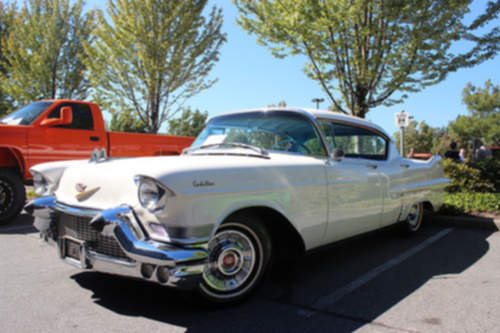
1949 Cadillac 2-door fastback sedanette
The heavier grille on the '49 was the product of consensus between Earl and Hershey. Back when the '48 was being designed in Hershey's farmhouse, there wasn't enough space to get a full-size clay model of the car into the room, but there was room for a full-size mock-up of the front end. Earl had come by the farm every week or so to check on the progress the design team was making. During one of his visits he told Hershey that he wanted a delicate, almost jewel-like grille treatment. Hershey complied, and this "delicate" grille appeared on the '48. When it came time to do the '49 facelift, Earl asked Hershey if he really liked the delicate grille. Hershey said that he did not. Earl then suggested a heavier treatment, which became the '49 front end.

1949 Cadillac 2-door fastback
One quick way to tell a '48 Caddy from a '49 when
seen from the rear is that the '48 had only one back-up light, while the '49
got two. Also, the '48 Series Sixty-Two models sported neat-looking triple
horizontal chrome slashes between the taillights and bumper, but they were
absent in 1949.

1949 Cadillac 4-door
The story of the changes
made inside the car for '49 paralleled that for the grille. Hershey found that
he wasn't ecstatic about the "rainbow" dash. Thus, the large bulge over the
instrument cluster which has endeared the '48 to so many automotive
enthusiasts was replaced in the '49 model with a more conventional hooded
horizontal speedometer. Critics have continually pointed out over the years
that the 1948-49 interiors were rather bland for Cadillac, the '49 especially
so. Others, as would be expected when dealing with matters of taste,
exclaim over the richness and simple elegance displayed by the interiors of
the two model years.

1949 Cadillac Fleetwood 75
The formidable 136-inch-wheelbase,
limited-production Series Seventy-Five remained much the same as it had
been in 1946-48 except that it, too, was now powered by the new V-8. It
might be noted that Cadillac had entered the decade with 10 distinct bodies
and exited with only five, the loss coming at the expense of the
Seventy-Five lineup. Explanation of the varied and often unexplainable
tastes of automobile collectors would probably merit writing a book. For
example, many collectors today prefer the '48 Series Seventy-Five models
for the sole reason that they were powered by the faithful old L-head,
despite the new engine's increased economy and efficiency.

1949 Cadillac convertible interior
One '49 Caddy much sought after by collectors is the Series Sixty-Two Coupe de Ville, a "hardtop convertible" introduced late in the model year. Though Cadillac had to share the honors with the Buick Riviera and Oldsmobile Holiday, this trio was the first to market this pillarless body style. The Coupe de Ville was basically a Series Sixty-Two convertible fitted out with a steel top, and featured a large wraparound three-piece rear window. Fitted out every bit as luxuriously as the ragtop, the Coupe de Ville even sported simulated top bows inside under the roof. That explains why the $3497 price tag was only $26 less than the ragtop's base price. Coupe de Ville output reached just 2150 units, but this new body style was destined to become all the rage in the Fifties.

1949 Cadillac 2-door
Perhaps it's fitting, then, that
when Cadillac produced its 1,000,000th car on November 25, 1949, it was
the sporty Coupe de Ville that rolled off the Clark Street assembly line in
Detroit. Though this milestone car was the last Cadillac of the Forties, it
was in truth a car fully poised for the Fifties.

1949 Cadillac 2-door
Also in November, Motor Trend
magazine named its very first "Car of the Year." The field was narrowed
down to three: Ford Oldsmobile, and Cadillac. Ford was eliminated first.
Despite "an entirely new chassis and body, plus many mechanical changes,"
wrote auto journalist John Bond, "it offers nothing new or outstanding
from an engineering viewpoint, since it now falls in line with conventional
design practices established by competitors before the war. The Cadillac
was chosen in preference to the Olds because, while both have outstanding
new V-8 engines which are similar, they are not by any means the same.
The Cadillac, with 10 per cent more piston displacement than the Olds,
develops 18.5 per cent more bhp and weighs a few pounds less." In
addition to the increased power of the new V-8, Bond cited "an even more
important advantage" of greatly increased durability. He also pointed out
that the new V-8 ". . . is brand new, and can normally be expected to be
continued with little change for a period of at least seven years." In this
regard, his assumption was certainly on the conservative side -- Cadillac
doubled that time period. Incidentally, Motor Trend followed up the
honors it bestowed on the '49 Cadillac by giving the similarly engineered
'52 models, now up to 190 bhp and about 200 pounds heavier, its
"Engineering Achievement Award."

1949 Cadillac convertible
The 1948-49 Cadillacs have also come in for latterday accolades. The Milestone Car Society, which honors the crème de la crème of postwar cars, has bestowed "Certified Milestone Car" status on the following models: Sixty-One Sedanet; Sixty-Two Sedanet, Convertible, and Coupe de Ville; Sixty Special; Seventy-Five Sedan/Limousine.
Cadillac Division could certainly take pride in the achievements of the Forties. And Franklin Q. Hershey could certainly take pride in the fact that he had finally been able to design production models of his first love -- Cadillac. In fact, with his development of the tailfins and the full-length flowing line, he had redefined Cadillac. And only about a million examples of the "Standard of Excellence" separated his last production Caddy from the first one his mother, Clara, had driven back in 1903!
The one-millionth Cadillac ever produced was a 1949 Coupe DeVille assembled Nov. 25, 1949.
The Milestone Car Society recognizes the following 1949 Cadillacs as Milestone Cars: